We Asked Pepcid a Simple Question. The Answer Highlights a Much Bigger Problem.

For many people living with Alpha-gal Syndrome (AGS), reading ingredient labels isn't a preference—it's a necessity.
Many AGS patients rely on medications such as Pepcid AC (famotidine) as part of their symptom management. Given how frequently medications are discussed within the AGS community, we reached out to Pepcid's consumer care team with a straightforward question:
Are there any mammalian-derived ingredients or trace mammalian byproducts in your product?
The response we received was:
"The source of these ingredients is not available. Many ingredients can be derived from a variety of sources, and the specific source material of these ingredients may change over time. While these ingredients must consistently meet strict specification requirements, we cannot provide the specific source of the ingredient used in your product. We strongly recommend that you consult a doctor before using any product if you have allergies or any other concerns."— Pepcid® Consumer Care Center
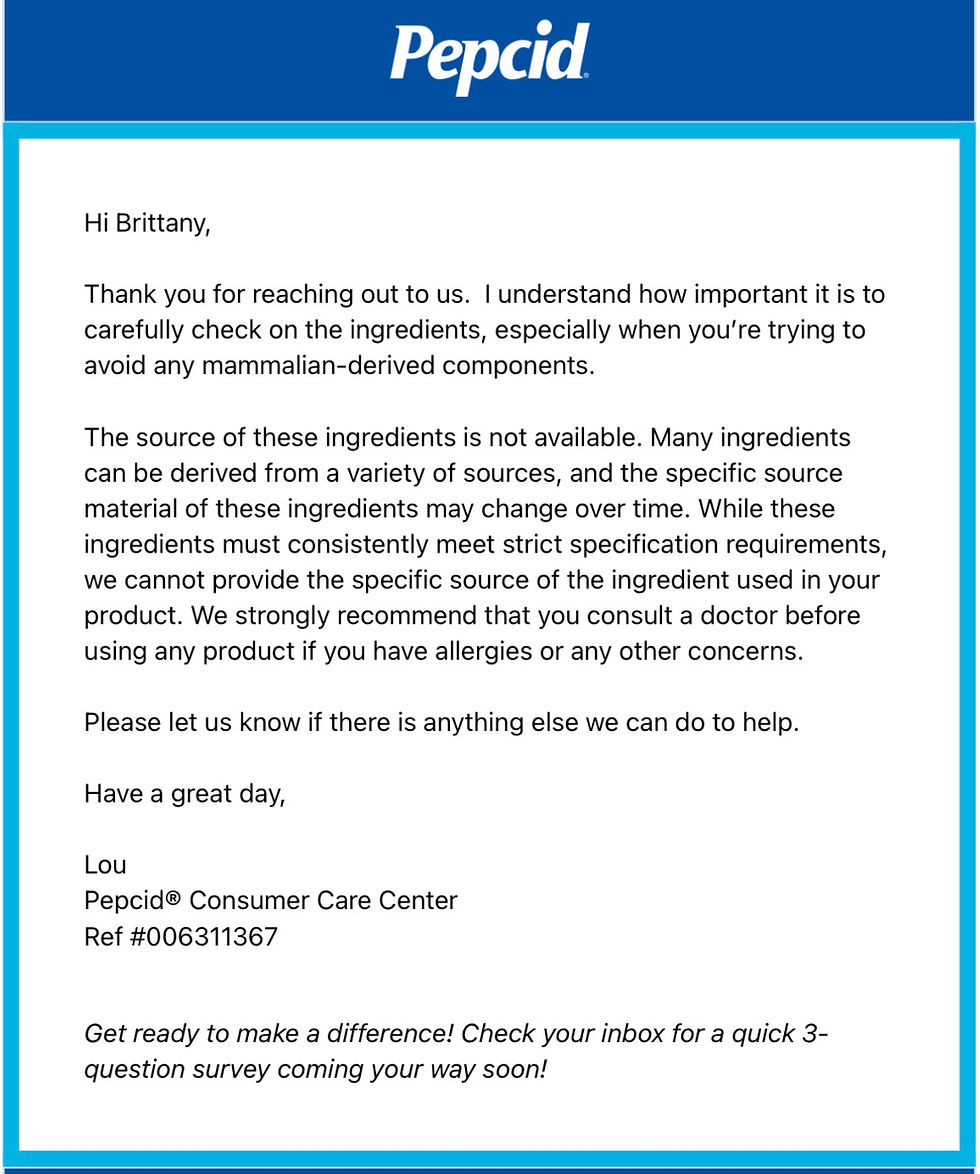
To be clear, Pepcid did not state that its product contains mammalian-derived ingredients.
But they also could not confirm that it does not.
And perhaps most importantly, they acknowledged that the source material of ingredients may change over time.
That answer highlights a much larger issue extending far beyond Alpha-gal Syndrome.
Patients Are Being Asked to Make Decisions Without Information
Imagine being told you have a medical condition that requires avoiding specific ingredients.
Now imagine the companies making the products cannot tell you where those ingredients come from.
That is the reality many AGS patients face every day.
It is also a reality familiar to many people living with:
Celiac disease
Food allergies
Mast Cell Activation Syndrome (MCAS)
Eosinophilic disorders
Rare metabolic disorders
Religious dietary restrictions
Vegan and vegetarian consumers
Patients are often expected to become experts in chemistry, pharmaceuticals, manufacturing, food science, and supply chain sourcing simply to determine whether a product might be safe.
And even then, the answer is frequently: "We don't know."
The Hidden Ingredients Problem
When most people think about ingredients, they focus on active ingredients.
Patients with specialized medical needs know that the real challenge often lies in the inactive ingredients.
Terms such as:
Magnesium stearate
Stearic acid
Glycerin
Gelatin
Lactose
Natural flavors
Mono- and diglycerides
may potentially originate from multiple sources.
A company may disclose that an ingredient exists.
But where did it come from?
Was the gelatin derived from pork?
Was the glycerin plant-based?
Was the magnesium stearate sourced from vegetable oils or animal fat?
Often, consumers are left guessing.
Even when they contact manufacturers directly, they may receive responses indicating that ingredient sourcing information is unavailable.
When the Ingredient Stays the Same, But the Source May Change
One aspect of Pepcid's response deserves special attention:
"Many ingredients can be derived from a variety of sources, and the specific source material of these ingredients may change over time."
For patients with Alpha-gal Syndrome, celiac disease, severe allergies, and other conditions that require careful screening of products, this raises an important question:
How can patients confidently rely on a product if the sourcing of its ingredients may change without being disclosed on the label?
The ingredient list may remain identical from one purchase to the next.
The product may look identical.
The packaging may look identical.
Yet according to the manufacturer's response, the source of certain ingredients could potentially vary over time. For most consumers, this may never be a concern.
For individuals whose health depends on avoiding specific ingredient sources, however, the distinction matters.
Many patients spend hours researching products, documenting what they tolerate, and building routines around medications and household items they believe are safe. When sourcing information is unavailable—or may change over time—that confidence becomes difficult to maintain.
The challenge is not necessarily that a product has changed.
The challenge is that patients often have no practical way to know whether it has.
Consistency Matters as Much as Transparency
For many patients, the goal isn't simply knowing what's in a product today.
It's knowing whether that product will remain the same tomorrow.
A medication that is tolerated for years becomes part of a patient's healthcare routine. If ingredient sourcing can change without clear disclosure, patients may be forced to repeatedly re-investigate products they have already vetted.
This creates a cycle of uncertainty that shifts responsibility from manufacturers to consumers. Patients should not have to repeatedly contact companies, compare manufacturing lots, search online forums, and rely on anecdotal reports simply to determine whether a product remains consistent with previous purchases.
Greater transparency around ingredient sourcing—and changes in sourcing—would help reduce that burden and allow patients to make more informed decisions about the products they use.
The Human Cost of Uncertainty
What happens when a company cannot answer these questions?
Patients become the testing mechanism.
Someone buys the medication ➡ Someone takes it ➡ Someone has a reaction—or doesn't ➡ Then that experience gets shared in a Facebook group, support forum, or online community ➡ Other patients use those stories to make healthcare decisions.
The process becomes:
Buy the product.
Hope it's safe.
Take it.
Wait.
See what happens.
That is not evidence-based medicine.
That is trial-and-error healthcare.
For patients who have experienced anaphylaxis, severe gastrointestinal reactions, neurological symptoms, repeated emergency room visits, or years of misdiagnosis, that uncertainty carries a real emotional burden.
Many patients describe spending hours researching products before purchasing them.
Many report calling manufacturers.
Many report receiving conflicting information.
Many ultimately decide not to use products simply because they cannot obtain clear answers.
Why Is the Burden on Patients?
Perhaps the most frustrating aspect of this issue is that the burden falls almost entirely on consumers.
Patients are expected to:
Read labels.
Research ingredients.
Contact manufacturers.
Investigate suppliers.
Search support groups.
Compare anecdotal reports.
Accept the risk if something goes wrong.
Meanwhile, ingredient sourcing remains largely opaque.
If a company changes suppliers, consumers are often never informed.
If an ingredient switches from one source to another, the label may remain unchanged.
The patient is left to discover the difference after purchase. Or after a reaction.
This Isn't Just an Alpha-gal Problem
While Alpha-gal Syndrome brought this issue to our attention, it is not unique to AGS. Individuals with celiac disease ( like myself ) often spend hours verifying products that should be straightforward.
Patients with severe food allergies routinely contact manufacturers seeking clarification beyond what appears on labels.
People with rare diseases, religious dietary restrictions, and ingredient sensitivities encounter many of the same obstacles.
The underlying issue is the same:
Consumers are expected to make highly informed healthcare decisions using incomplete information.
In many cases, they are told to consult their physician.
But physicians often do not have access to ingredient sourcing information either.
That leaves patients, pharmacists, physicians, and manufacturers all operating with different pieces of the puzzle.
Transparency Should Not Be a Luxury
In an era where consumers can track packages in real time, review the origin of produce at grocery stores, and instantly access detailed nutritional information, it seems reasonable to ask for greater transparency regarding ingredient sourcing.
Patients should not have to become private investigators to determine whether a medication, supplement, shampoo, cosmetic, detergent, or food product is safe.
Transparency does not require companies to reveal proprietary formulas.
It simply requires providing consumers with meaningful information about ingredient origins and notifying them when those sourcing practices change.
For many patients, that information can be the difference between confidence and fear.
A Conversation Worth Having
The purpose of sharing Pepcid's response is not to criticize a single company. In many ways, their response reflects a broader industry reality.
The issue is bigger than one medication.
The issue is bigger than Alpha-gal Syndrome.
The issue is whether patients should have access to clear, consistent information about the products they put in and on their bodies.
If a patient must avoid a particular ingredient source for medical reasons, shouldn't they have the right to know where that ingredient came from?
And if sourcing may change over time, shouldn't they have the right to know that too?
Because no patient should have to become a guinea pig simply to find out whether a product is safe.
Disclaimer
The response referenced in this article was provided by Pepcid® Consumer Care Center in response to an inquiry regarding ingredient sourcing. Pepcid did not state that its products contain mammalian-derived ingredients, nor did it confirm that they are free of mammalian-derived ingredients. This article is intended to discuss transparency and ingredient sourcing challenges experienced by patients with specialized dietary and medical needs. It should not be interpreted as a claim regarding the safety, composition, or sourcing of any specific Pepcid product. The views expressed are those of the author and are intended to encourage discussion regarding consumer transparency and informed decision-making.