Beyond the Allergic Reaction: What Alpha-Gal Patients Are Reporting About the Heart

Low blood pressure during anaphylaxis is not a surprising finding. Low blood pressure when there is no apparent allergic reaction is a different question entirely.
There is an important distinction we need to make before talking about the cardiovascular symptoms appearing in our latest Alpha-gal data. Alpha-gal Syndrome can cause severe allergic reactions, and cardiovascular changes can occur during those reactions. Blood pressure can fall, heart rate can increase, and a person may become dizzy, faint or, during a severe reaction, experience cardiovascular collapse.
That is the cardiovascular side of an allergic reaction. What caught our attention in the latest data was something different.
Some respondents describe low blood pressure, rapid heart rate, dizziness and other cardiovascular problems not simply as events occurring during a known allergic reaction, but as recurring or persistent parts of their lives after developing Alpha-gal Syndrome. One respondent wrote simply, “Low blood pressure is constant.” Another described how “high heart rates and low blood pressure” had become frightening parts of living with the condition.
These experiences raise a different question from whether anaphylaxis can cause hypotension or tachycardia. Those relationships are already recognized. The question raised by these patients is what may be happening between the reactions.
When we looked more closely at the data, the cardiovascular signal was difficult to overlook.
What the Latest Data Shows
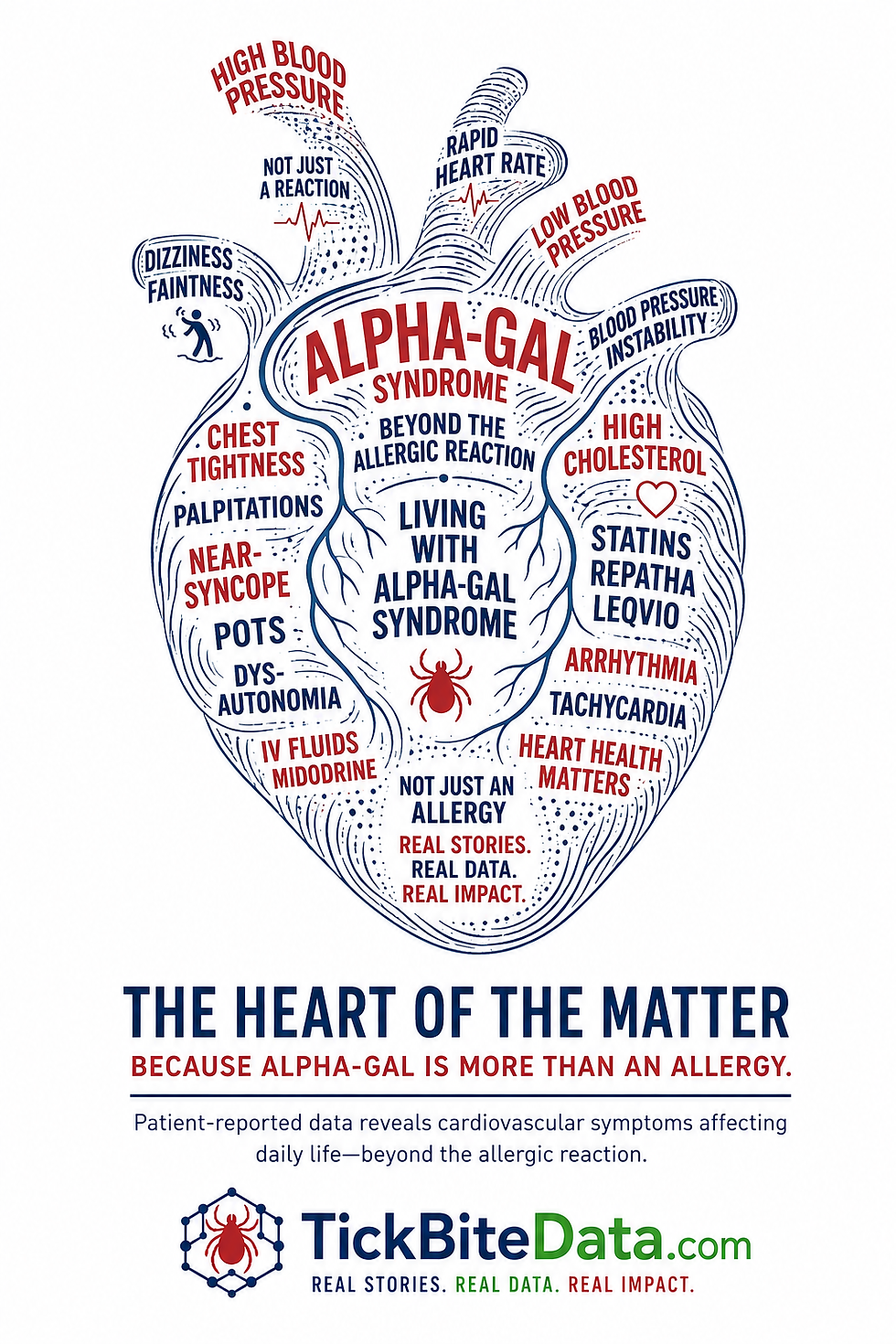
In the latest analysis, 58.9% of respondents selected at least one symptom in the cardiovascular section of the survey. Dizziness was reported by 43.9%, rapid heart rate by 40.1%, low blood pressure by 24.8% and high blood pressure by 16.4%.
Some of those reports will reflect cardiovascular symptoms occurring as part of an allergic reaction. The survey contains descriptions of exactly that experience. One respondent described what happens before anaphylaxis, writing that their blood pressure drops to approximately 65/36. Another described episodes involving very low blood pressure and fainting during a reaction, with epinephrine resolving the episode.
Those experiences fit within the cardiovascular picture of a severe allergic response. Other respondents, however, describe blood-pressure problems occurring daily, low blood pressure requiring IV fluids, medication prescribed specifically to raise blood pressure, months of cardiac testing, persistent palpitations and episodes of high blood pressure without describing the hives, swelling or other allergic symptoms they expected to accompany a reaction.
That second group deserves a closer look.
When the Heart Looks Healthy but the Patient Doesn't Feel Well
One respondent described sudden low-blood-pressure episodes occurring every day and undergoing six months of cardiac testing before being told the heart itself appeared healthy. According to the respondent, the cardiologist had not heard of Alpha-gal. Another healthcare professional eventually recognized the possibility and ordered testing.
“It took 6 mos. of thorough cardiac testing to pronounce my heart healthy.”
After receiving an Alpha-gal diagnosis, the patient described eliminating mammalian exposures and reported that the low-blood-pressure episodes eventually stopped.
“Low BP episodes have ceased, though it took weeks.”
That experience illustrates why separating acute allergic cardiovascular symptoms from longer-term cardiovascular complaints matters. Another respondent reported “critically low blood pressure” requiring IV fluids and said they had been prescribed midodrine, a medication used to raise blood pressure.
These patients are describing cardiovascular problems significant enough to result in specialist testing, medication, emergency treatment and changes to daily life. Their experiences raise questions that extend beyond what happens to blood pressure during an obvious allergic reaction.
Low Blood Pressure Isn't the Only Signal
We initially went looking for hypotension because low blood pressure kept appearing in patient conversations. The data confirmed that it deserved attention, with nearly one-quarter of respondents, 24.8%, selecting low blood pressure.
The analysis also revealed another signal: 16.4% reported high blood pressure, and 194 respondents reported experiencing both low and high blood pressure over the course of their illness.
That does not mean these respondents were simultaneously hypertensive and hypotensive, and the current survey does not tell us when each occurred. The finding does raise a different question from whether Alpha-gal patients simply experience low blood pressure: are some patients experiencing blood-pressure instability?
Patient comments make the question worth exploring. One respondent wrote, “I also developed high blood pressure right about the time I was diagnosed. I never had high blood pressure before diagnosis.” Another described rapid heart rate and high blood pressure as the symptoms that ultimately prompted Alpha-gal testing and reported that those symptoms later resolved.
Other respondents describe blood-pressure spikes, palpitations, rapid heart rate, faintness and periods of unusually low pressure. The current survey was not designed to determine whether these experiences represent autonomic dysfunction, cardiovascular disease, consequences of allergic reactions or another process. What the data does show is that the patient experience extends beyond the simple description of blood pressure dropping during anaphylaxis.
The Cardiovascular Group Is Reporting Greater Severity
The relationship between cardiovascular symptoms and overall symptom severity adds another layer to the findings. Across respondents answering the severity question, 51.2% described their Alpha-gal symptoms as severe or debilitating.
Among respondents reporting low blood pressure, that increased to 66.0%. Severe or debilitating symptoms were reported by 61.5% of those reporting high blood pressure, 59.8% of those reporting rapid heart rate and 60.1% of those reporting dizziness.
These comparisons do not tell us what is driving the difference. People experiencing more severe AGS may simply report more symptoms across multiple categories. They do tell us that the respondents reporting cardiovascular problems are disproportionately represented among those describing a severe or debilitating experience.
For these patients, cardiovascular complaints are not an insignificant footnote to their Alpha-gal experience.
The Symptoms That Send Patients to Cardiology
The comments also reveal how cardiovascular symptoms can complicate the diagnostic journey. Some respondents describe believing they were having heart attacks, while others underwent cardiac monitoring, imaging and specialist evaluations before Alpha-gal entered the conversation.
One respondent described an assumption that their symptoms were heart-related, followed by cardiac testing that did not reveal an explanation. Medication adjustments and additional testing also failed to provide an answer before an Alpha-gal blood test was eventually performed.
Another described rapid and forceful heartbeats and palpitations alongside tingling in the arms, legs and face. The respondent reported that the symptoms resolved after eliminating mammalian products.
These experiences reflect a pattern we have encountered elsewhere in the data. A patient with persistent gastrointestinal problems may be sent toward gastroenterology. Tremors or other neurological complaints can lead in another direction. Low blood pressure, palpitations or rapid heart rate may understandably lead to cardiology.
The problem arises when the specialist evaluation does not reveal an explanation and the patient's symptoms continue. At that point, what happens next may depend on whether anyone considers that seemingly unrelated symptoms could belong to a broader clinical picture.
What About POTS and Dysautonomia?
The cardiovascular findings led us to look more closely at another group of responses. In the smaller treatment survey, respondents were asked about diagnosed cardiovascular and autonomic conditions. Among 103 participants, 7 reported a POTS diagnosis and 4 reported dysautonomia. Thirteen reported a diagnosed rapid heart rate, 11 reported tachycardia and 8 reported arrhythmia.
This smaller treatment survey is not large enough to estimate how common these diagnoses are among people with Alpha-gal Syndrome. Their presence is still noteworthy because respondents in the larger survey independently describe symptoms that can overlap with cardiovascular and autonomic disorders, including dizziness, rapid heart rate, faintness and blood-pressure abnormalities. Some respondents also spontaneously mention POTS or dysautonomia in their comments.
These findings show us where the survey needs to become more specific. Future questions should distinguish blood-pressure abnormalities occurring during an allergic reaction from those occurring without a known exposure. They should ask about positional changes, fainting and near-fainting, autonomic testing, and whether diagnoses such as POTS or dysautonomia occurred before or after the onset of Alpha-gal symptoms.
The current data has identified a signal. Better questions may help us understand what is behind it.
Then We Found Cholesterol
While examining cardiovascular symptoms and treatment data, another finding caught our attention. In the smaller treatment survey, 51 of 103 respondents, or 49.5%, reported having been diagnosed with high cholesterol. Thirty respondents reported currently taking a statin, while two reported taking Repatha (evolocumab).
Because this is a small, treatment-focused survey, these numbers should not be interpreted as the prevalence of high cholesterol or cholesterol-medication use among everyone with Alpha-gal Syndrome. Nearly half of this particular sample reporting high cholesterol is enough, however, to make the question worth investigating more deliberately.
Comments in the larger survey added to that interest. One respondent wrote, “I had no problem with cholesterol until I got alpha gal.” Another reported, “High cholesterol since AGS.” A respondent in their 30s described testing positive for Alpha-gal and having high cholesterol despite being normal weight and eating what they considered a mostly healthy diet, while another described developing “high cholesterol at early age.”
These observations do not yet tell us whether Alpha-gal and cholesterol are connected. They tell us that the question deserves to be measured properly rather than answered through anecdotes.
Future analysis should examine whether cholesterol abnormalities began before or after Alpha-gal symptoms, whether levels changed after mammalian avoidance, whether they persist among people who have resumed eating mammalian foods, and which cholesterol-lowering medications patients are using. The current dataset has made cholesterol interesting enough to investigate; the next round of data should help determine whether a meaningful pattern actually exists.
Are We Looking at the Reaction—or the Condition?
The distinction that started this analysis becomes increasingly important as the cardiovascular findings are viewed together.
If someone with Alpha-gal experiences hypotension, tachycardia and dizziness during anaphylaxis, those cardiovascular symptoms have an established place within an allergic reaction. The harder questions concern the patient whose low blood pressure is described as constant, the person requiring medication to raise their blood pressure, the respondent reporting experiences with both high and low blood pressure, or the patient whose rapid heart rate and hypertension prompted a search for answers.
Those experiences should not automatically be folded into the acute allergic reaction simply because cardiovascular symptoms can occur during anaphylaxis. They deserve to be examined separately so we can understand whether something different is occurring in at least a subset of patients.
The absence of an established explanation does not make a recurring patient experience disappear. It simply means the explanation has yet to be established.
The Numbers Are Asking a Different Question
Patient-reported research has limitations, but one of its strengths is its ability to reveal patterns across independently submitted experiences. With more than 3,000 survey responses, recurring signals become increasingly difficult to dismiss as isolated anecdotes.
In the latest analysis, 43.9% report dizziness, 40.1% rapid heart rate, 24.8% low blood pressure and 16.4% high blood pressure. Nearly 59% report at least one symptom captured within the cardiovascular section of the survey. Respondents reporting these cardiovascular symptoms are also more likely than respondents overall to describe their illness as severe or debilitating.
Those numbers do not provide the mechanism, but they clearly identify the question.
For years, much of the conversation surrounding Alpha-gal has understandably centered on allergic reactions. Anaphylaxis can be life-threatening, and recognizing it saves lives. Focusing on the allergic reaction alone, however, may leave another group of patients without an explanation for what they experience between reactions.
If low blood pressure, high blood pressure, rapid heart rate, dizziness, faintness and other cardiovascular complaints continue appearing throughout patient-reported data, they deserve focused investigation beyond their role in anaphylaxis.
Perhaps the cardiovascular question surrounding Alpha-gal is no longer simply what happens to the heart during an allergic reaction. We also need to ask what is happening to some patients' cardiovascular systems when they are living with Alpha-gal Syndrome.