

When the Smell Alone Triggers Symptoms: What Alpha-gal Patients Are Reporting About Fumes and Sensory Reactions

Patient-reported observations from TickBiteData.com
For many people, Alpha-gal Syndrome is initially described as a delayed allergic reaction to mammalian meat products after a tick bite.
But among patient-reported experiences submitted to TickBiteData.com, another pattern continues to appear repeatedly: Some individuals report reactions not only after eating mammalian products — but also after exposure to cooking fumes, smoke, strong smells, perfumes, cleaning products, and airborne exposure.
While these experiences are not yet fully understood scientifically, the consistency of these reports raises important questions about how Alpha-gal Syndrome may affect sensory sensitivity, airborne exposure responses, mast cell activation, inflammation pathways, and quality of life.
Sensory Reactions and the Allergy Response
One of the more complex discussions emerging within the Alpha-gal community involves reactions connected to smell, airborne exposure, and sensory sensitivity.
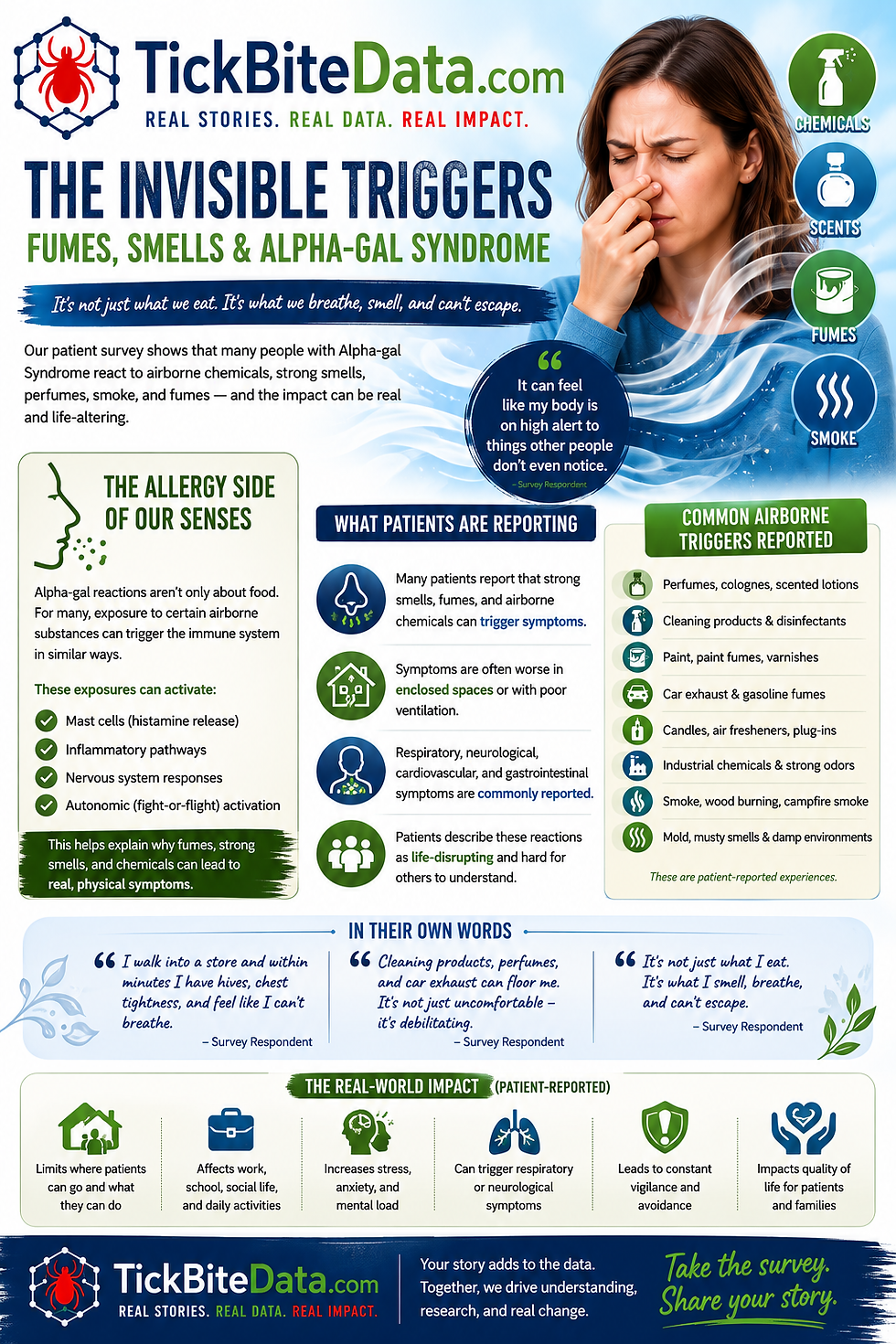
Traditionally, Alpha-gal Syndrome has been described as a delayed allergic reaction associated with consuming mammalian products. However, many patients participating in TickBiteData.com describe experiences that appear to extend beyond ingestion alone.
Some respondents report symptoms triggered by:
cooking meat fumes
smoke exposure
perfumes and air fresheners
heated dairy products
cleaning chemicals
restaurants with heavy cross-contamination
topical products containing mammalian-derived ingredients
The severity described varies significantly.
Some participants report mild discomfort such as headaches, sinus irritation, flushing, or nausea. Others describe more severe reactions involving breathing difficulty, rapid heart rate, dizziness, gastrointestinal distress, or symptoms they associate with anaphylaxis.
These reports raise important scientific questions about how the immune system, histamine pathways, sensory processing, inflammation, and environmental exposure may interact in some individuals with Alpha-gal Syndrome.
One participant described the unpredictability this creates:
“I never know if I will have a reaction when I leave my home.”
Another shared:
“People need to realize you do not have to ingest mammal to react. I am fume and topical reactive.”
While these observations remain patient-reported and require further scientific investigation, the consistency of these discussions across the community continues to stand out.
Airborne Reactions and Cooking Fumes
Among the most frequently discussed sensory-related concerns are cooking fumes and airborne food exposure.
Some survey participants describe symptoms occurring while mammalian products are being cooked nearby, particularly in enclosed spaces such as homes, restaurants, food labs, cafeterias, or social gatherings.
Several respondents specifically referenced:
grilling meat
frying bacon
roasting beef
heated butter or dairy
smoke from cooking surfaces
One participant reported:
“Started out with allergy to mammal meat and dairy. Can now tolerate dairy but anaphylactic reaction to mammal meat, including fumes while cooking.”
Another shared:
“My symptoms range from sinus drainage (mild) to anaphylaxis from fumes.”
Others described needing to avoid restaurants entirely or isolate themselves when mammalian products are prepared inside the home.
The mechanism behind these experiences remains unclear.
Researchers studying allergies have long recognized that airborne particles can trigger reactions in certain conditions. However, the role of airborne exposure in Alpha-gal Syndrome remains an area where formal research is still limited.
This uncertainty leaves many patients attempting to navigate symptoms that they say significantly affect daily life, social interaction, travel, and work.
Beyond Food: Smells, Chemicals, and Sensory Sensitivity
Some participants report that their sensitivity appears to extend beyond food exposure itself.
Survey responses describe reactions associated with:
perfumes
cigarette smoke
vaping
cleaning products
asphalt and chemical odors
lotions and soaps
toothpaste
air fresheners
These experiences may overlap with broader conversations involving mast cell activation, histamine intolerance, nervous system dysregulation, inflammation, or heightened sensory sensitivity.
At this time, researchers still do not fully understand why some individuals with Alpha-gal report these experiences while others do not.
What is clear from patient reports, however, is that many individuals feel these symptoms are dramatically affecting quality of life.
One participant shared:
“Our church uses air fresheners and I am highly reactive to them.”
Another described how these sensitivities changed daily life entirely:
“My entire life has changed.”
As patient-reported datasets continue to grow, questions surrounding environmental exposure and sensory reactivity may become increasingly important areas for future scientific investigation.
The Social and Emotional Impact
For many respondents, the emotional impact appears just as significant as the physical symptoms.
One participant wrote:
“I am now fume reactive and cannot go to any restaurants.”
Another shared:
“AG destroyed my dental health. Have left me isolated. Everything I can have delivered I do. Rarely leave property.”
Participants frequently describe:
fear around public spaces
difficulty attending family events
social isolation
anxiety around travel
challenges at work
difficulty explaining symptoms to others
frustration with medical dismissal
Some report being told their symptoms were anxiety-related before eventually learning about Alpha-gal Syndrome.
What Science Currently Knows — and Doesn’t Know
Researchers have documented that Alpha-gal Syndrome can involve delayed allergic reactions to mammalian-derived products. Some individuals also report reactions to gelatin, medications, dairy, and cross-contamination.
However, airborne exposure and sensory-triggered symptoms remain less understood.
TickBiteData.com does not claim that all people with Alpha-gal experience these reactions.
Rather, the goal is to document and organize patient-reported experiences that may help identify patterns deserving of additional scientific attention.
Why Patient-Reported Data Matters
Historically, many chronic illnesses and emerging syndromes were first recognized because patients consistently reported similar experiences before formal research fully explained them.
The recurring discussion around fumes, smells, and sensory sensitivity within the Alpha-gal community highlights why patient-reported datasets may help identify areas requiring deeper investigation.
As more individuals participate, patterns become harder to ignore.
If you or your family have experienced Alpha-gal Syndrome, tick-related illness, airborne reactions, or unusual sensory sensitivities after tick exposure, your experience may help contribute to a better understanding of these conditions.
👉 Participate in the survey at www.TickBiteData.com
This article discusses patient-reported experiences collected through TickBiteData.com and is intended for educational and awareness purposes only. It is not medical advice and does not establish causation.


