

Neurological Symptoms in Children with Alpha-gal: What We’re Seeing From Families Worldwide
When most people hear “Alpha-gal,” they think of a food allergy—something you can control by avoiding red meat.
But based on what families are sharing with us through our voluntary surveys at TickBiteData.com, that’s not the full story—especially when it comes to children.
We’re starting to see a pattern that’s harder to explain as “just an allergy.”
🌍 This Isn’t Just Happening in One Place
Through our survey, we’ve received responses from families with children across:
🇺🇸 United States
🇦🇺 Australia
🇨🇦 Canada
🇬🇧 United Kingdom
🌍 Additional global submissions continuing to grow
Even with differences in tick species, geography, environment, and healthcare systems…
👉 The symptom patterns are strikingly similar.
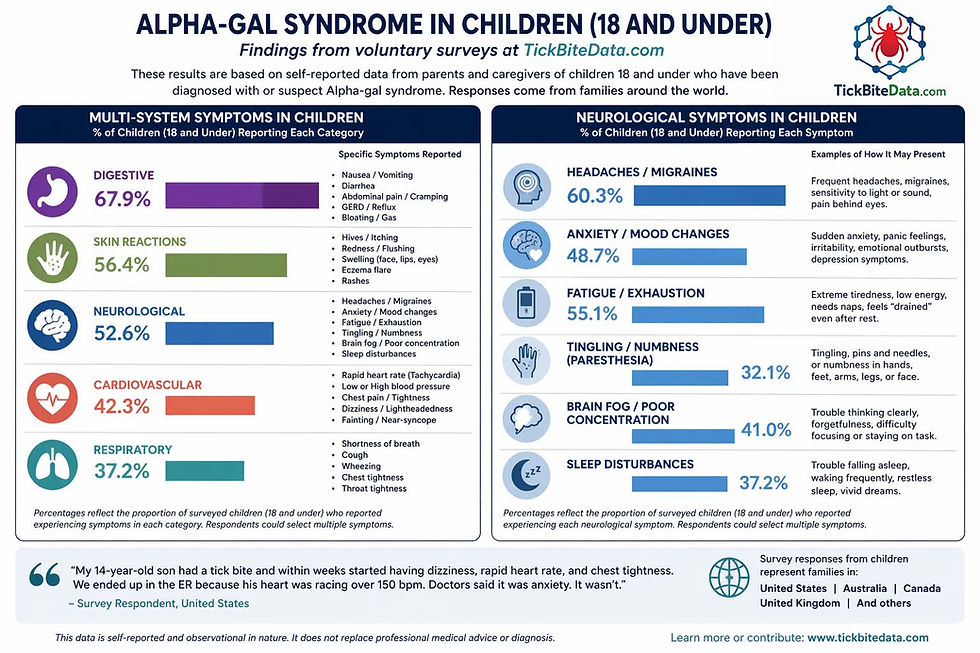
📊 What Our Survey Data Shows in Children (18 and Under)
From pediatric responses submitted to our voluntary survey:
Nearly 68% report digestive symptoms
Over 56% report skin reactions
Over 50% report neurological symptoms
Over 40% report cardiovascular involvement
This isn’t one symptom.This isn’t one system. This is multi-system involvement—in children.
🧠 Let’s Talk About the Neurological Symptoms
This is where things start to stand out.
From our survey data, children are experiencing:
Frequent headaches or migraines
Anxiety or sudden mood shifts
Persistent fatigue (even with rest)
Tingling or numbness (hands, feet, or face)
Difficulty concentrating / brain fog
Sleep disturbances
These aren’t rare, one-off complaints. Families are reporting these symptoms together, repeatedly, and over time.
💬 What Families Are Saying
From real survey responses:
“My child avoids all mammal products, but still has episodes of fatigue and anxiety that come out of nowhere.”
“We thought it was migraines at first, but the symptoms didn’t follow any normal pattern.”
“The tingling and numbness scared us—it didn’t make sense for a ‘food allergy.’”
“Doctors kept saying anxiety, but it didn’t explain everything else going on.”
These are not isolated experiences.They’re part of a pattern we’re seeing across responses.
⚠️ Symptoms Without Clear Food Triggers
One of the most consistent—and concerning—themes:
Many children are experiencing neurological symptoms:
Without recent exposure to mammalian foods
Despite strict dietary avoidance
At random or delayed intervals
This raises an important question:
👉 If this were only a food allergy… why are symptoms happening without food?
🔍 Why This Doesn’t Fit the Traditional Allergy Model
Typical food allergies tend to present with:
Hives
Swelling
Anaphylaxis
Clear trigger → reaction timeline
They do not typically present with ongoing or unpredictable neurological symptoms like:
Brain fog
Mood changes
Nerve sensations
Chronic fatigue
The patterns reported in our survey suggest something more systemic may be happening.
⚠️ The Misdiagnosis Problem (Especially in Kids)
Because these symptoms don’t look like a classic allergy, many children are initially labeled with:
Anxiety disorders
Behavioral or attention-related conditions
Migraines
Chronic fatigue
And in many cases:👉 Alpha-gal isn’t even considered. Especially when symptoms aren’t clearly tied to food.
🧬 What This Could Mean
To be clear—this is patient-reported, voluntary survey data, not a clinical trial.
But the consistency is hard to ignore.
Across countries, ages, and backgrounds, families are describing:
Neurological symptoms
Multi-system involvement
Reactions not always tied to food
Which suggests: Alpha-gal in children may involve more than a traditional IgE-mediated allergic response—it may have systemic or inflammatory components that are not yet fully understood.
👩⚕️ Why This Matters
If these patterns continue to be overlooked:
Children may go undiagnosed or misdiagnosed
Symptoms may be dismissed or minimized
Opportunities for early intervention may be missed
And most importantly:👉 Families are left trying to piece this together on their own
📣 Help Us Build the Data
Everything we’re learning comes directly from families willing to share their experiences.
If your child has Alpha-gal or has experienced symptoms following a tick bite:
👉 Contribute to the survey: www.tickbitedata.com
The more data we collect, the clearer this picture becomes—and the harder it is to ignore.


