

Australia’s Biosecurity Under Pressure: Cattle Tick Infestations and the Alpha-gal Connection

Australia has long been recognized for having some of the most stringent biosecurity measures in the world. Its geographic isolation and strict import controls have helped protect the continent from many invasive species and agricultural threats.
However, when it comes to ticks and the conditions they may trigger, including Alpha-gal syndrome (AGS), the challenge may not be coming from outside Australia’s borders—but from within.
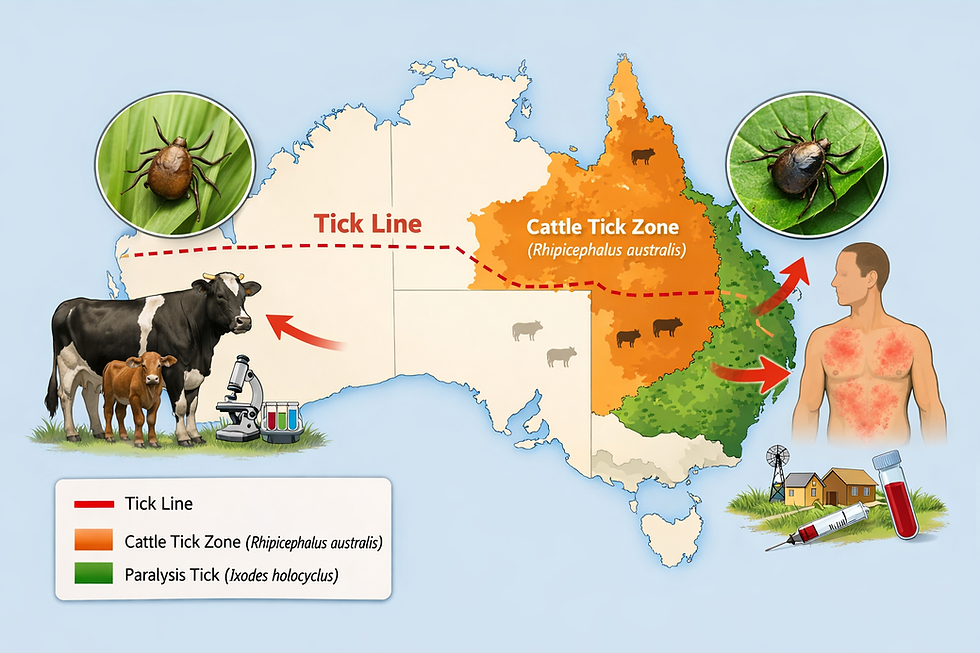
Australia’s Biosecurity Strength—And Its Limits
Australia’s biosecurity system is designed to prevent the introduction of foreign pests, diseases, and parasites. This has been largely successful in protecting livestock industries and ecosystems from many global threats.
Yet ticks present a unique problem.
Unlike invasive species that arrive via shipping or travel, ticks are already well established across Australia, particularly in coastal and bushland regions. Species such as the Australian paralysis tick (Ixodes holocyclus) are widely known for causing severe reactions, including paralysis in animals and allergic responses in humans.
As climate conditions shift and tick populations expand, human exposure is increasing—bringing renewed attention to the health consequences of tick bites.
Alpha-gal Syndrome: Not Just an American Condition
Alpha-gal syndrome is a delayed allergic reaction to mammalian meat and byproducts, triggered by a sugar molecule known as galactose-α-1,3-galactose (alpha-gal). In the United States, it has been strongly linked to bites from the Lone Star tick.
For years, this association led to a widespread assumption that Alpha-gal syndrome was geographically limited.
That assumption is now being challenged.
Emerging research and patient reports from around the world—including Australia, Africa, and Europe—suggest that multiple tick species may be capable of triggering Alpha-gal sensitization.
New Evidence from Australia: Confirmed Cases in Queensland & New South Wales
Recent data collected through TickBiteData.com is beginning to shed light on the presence of Alpha-gal syndrome within Australia itself.
Several confirmed cases have now been reported in Queensland and New South Wales revealing a consistent and clinically significant pattern:
Individuals experienced a tick bite within Australia
Followed by delayed allergic reactions after consuming mammalian products, including beef, pork, and dairy
Symptoms ranged from hives and gastrointestinal distress to full anaphylaxis
Diagnosis was confirmed through blood testing for Alpha-gal-specific IgE antibodies
These findings are important—not because they prove widespread prevalence, but because they demonstrate documented, real-world cases occurring within Australia.
They also reinforce a critical point:
Alpha-gal syndrome is not limited to one tick species or one region.
The Hidden Burden: Delayed Diagnosis and Misunderstanding
One of the most consistent themes among Alpha-gal patients globally is the delay in diagnosis.
Because reactions are often delayed by several hours after eating, patients and healthcare providers frequently fail to connect symptoms to food exposure. Many individuals report:
Months or years of unexplained symptoms
Misdiagnoses, often as gastrointestinal disorders or anxiety
Multiple healthcare visits before receiving appropriate testing
The confirmed cases emerging from Australia reflect this same pattern—highlighting a gap in awareness that extends beyond the United States.
Biosecurity vs. Emerging Conditions
Australia’s biosecurity framework is highly effective at preventing external threats—but alpha-gal syndrome represents a different category of risk.
This is not an imported disease.
It is likely:
Developing domestically
Associated with native tick species
Under-recognized within current medical frameworks
The presence of confirmed cases raises important questions for both public health and research communities:
Are certain Australian tick species capable of inducing Alpha-gal sensitization?
How widespread is the condition?
Should alpha-gal syndrome be included in standard diagnostic protocols for unexplained allergic reactions?
The Role of Patient-Driven Data
One of the most important aspects of these findings is how they were identified.
These cases did not emerge from large-scale institutional studies—they came from individuals sharing their experiences through TickBiteData.com.
This underscores a powerful reality:
Patient-reported data is playing a critical role in identifying emerging health conditions in real time.
As more individuals contribute their experiences, patterns begin to form—often well before formal recognition catches up.
A Global Call to Awareness
The emergence of confirmed Alpha-gal cases in Australia reinforces a broader shift in understanding:
Alpha-gal syndrome is a global, emerging condition—not a localized anomaly.
For healthcare providers, researchers, and public health officials, this means:
Expanding awareness beyond region-specific assumptions
Considering alpha-gal syndrome in cases of unexplained or delayed anaphylaxis
Supporting data collection efforts to better map its global distribution
For patients, it means recognizing that symptoms following a tick bite—no matter where in the world—should not be dismissed.


